Saturday, September 23, 2006

Vaccinating Your Shih Tzu

Active immunization is the introduction into the body of killed or satisfied microorganisms or their products for the purpose of stimulating the Shih Tzu’s defense mechanism. This is the same concept that is applicable to the human species.


Historically the area of veterinary medicine had not yet realized the potential benefits of vaccinations. It hasn't been until recently, those veterinary experts formulated solutions to combat the alarming increased of death in dogs and the Shih Tzu as well. Most of the causes are viral infection.


With the inception of vaccinations, many dogs and Shih Tzu were saved from probable death brought about by many diseases like leptospirosis, hepatitis, upper respiratory infections and parvovirus.


Like humans, dogs need vaccinations even at an early age. That is why it is important to immunize Shih Tzu puppies so that they will survive until they are fully grown.
Basically, Shih Tzu puppies get their immunity from their Shih Tzu mother’s milk, which is also the same as that of human beings. However, these immunities tend to lose their effects by the time the Shih Tzu puppies are already 6 to 20 weeks old. It is during this time they need to be immunized.


In order to protect the Shih Tzu puppies against infectious diseases, it is best to give them their shots. Shih Tzu puppies should be re-immunized after 3 to 4 weeks for 4 rounds. Thereafter, the Shih Tzu dog should receive a booster yearly. If you follow this regimen, Shih Tzu puppies should be able to endure any infectious disease that may come their way.


Rabies and Immunization
Rabies is an acute and almost invariably fatal disease communicated to man through the saliva of a rabid animal, usually dogs, foxes, squirrels, and bats.
Dogs, fortunately, always present evidence of the disease before becoming infective. The etiologic agent is an ultramicroscopic virus present in the saliva and the central nervous system.
The course of rabies in dogs and Shih Tzu is characterized by an incubation period of 20 to 30 days. This is followed by a period of excitement, when the animal becomes vicious. The excitement stage may be evident or may be entirely absent. Paralysis develops which first involves the Shih Tzu’s hind legs and thereafter becomes generalized. Death occurs within 10 days following the first symptom.


Alternatively, the effects of rabies in human beings can be fatal as it is with dogs and Shih Tzu. Hence, in order to avoid these problems, it is best to have your Shih Tzu and all dogs vaccinated with anti-rabies shots.


Rabies vaccines can be given during the 16th to the 26th week of the life of a Shih Tzu puppy. This requires a follow up shot once yearly in most areas for total protection.
On the other hand, dog and Shih Tzu owners should take note that vaccinations can generate adverse effects on their dogs and Shih Tzu. So, it is best to always observe your dog or Shih Tzu after vaccination. When reactions such as vomiting, facial swelling or trembling occur, it is best to consult with your veterinarian immediately.


Vaccination Tips:
• Consider the age of the Shih Tzu puppy before subjecting them to their shots.

• First shots for a Shih Tzu puppy should be between the age of 6 and 8 weeks. Two to four weeks later another shot can be given until you have completed four rounds.

• Rabies vaccinations should be given between the ages of 16 to 26 weeks, and then once yearly.

• Booster shots for the common diseases in dogs and Shih Tzu should be given yearly to the adult Shih Tzu.


In conclusion, vaccinations are extremely important to your Shih Tzu’s life. Vaccines are needed in order to protect the Shih Tzu from imminent risk of acquiring diseases brought about by viruses.


Once you have vaccinated your Shih Tzu properly you can rest assured that he or she will be at its peak of health for a longer period of time. Indeed, vaccines are essential to the long life of your Shih Tzu. Do not omit this part of your health program for the Shih Tzu.


Author: Connie Limon. I raise Shih Tzu puppies. Please visit us, sign up for our newsletter and purchase puppies online at: http://www.stainglassshihtzus.com/
This article is FREE to publish with the resource box.

Tuesday, September 12, 2006

Grooming and Beautifying Your Shih Tzu

Grooming and Beautifying Your Shih Tzu

Although the day-to-day care of the show dog exceeds the grooming required for a pet dog, the groomer has a responsibility to perform a work of art in both cases.

Training and experience helps a groomer to look at a photograph of any Shih Tzu and to know instantly which bits of hair are clipped or scissor.

Expert brushing is an art. You might be shocked to find out your carefully brushed Shih Tzu still has tangles when a more experienced person gets a bin full of hair when complete brushing takes place. There is more to brushing your Shih Tzu than you probably realize.

Brushing Steps:

Put the Shih Tzu on the table.
Start on the bottom of the fore left leg. Lift the hair above the section you are working on, and brush the section below.
Comb through the coat. Use a grooming spray if necessary. Continue up the leg.
Continue the brushing and combing across the Shih Tzu’s quarters, along the back and neck. Pay special attention to behind the ears and underneath the legs. Matting is often more likely to occur in these areas.
Brush the head, ears and whiskers. Use a small comb on the Shih Tzu’s whiskers. The hair at the base of the Shih Tzu’s ears will need to be combed to remove tangles.
Lay the Shih Tzu on its side. Pay particular attention to the armpits where hair often mats.
Brush the hair on the hindquarters where the coat often grows thick and mats.
Brush the tail.


Mat breaking:

A mat-breaker or slicing the mat with scissors may be required.
Splitting the hair with your fingers will also help to break apart the tangles.
Always hold the Shih Tzu’s skin or the base of the mat when pulling; otherwise, you will pull at the Shih Tzu’s skin and cause great pain.

The finished result is called turning out a dog or in our case, turning out a Shih Tzu.

A professional groomer will have to know before the groom whether they are working on a show Shih Tzu or a pet Shih Tzu. There are many aids and coat-enhancing properties that are great for a pet Shih Tzu, but may be illegal substances in the show ring. In North America, Shih Tzu and other breeds are prepared for the show ring by clipping and coat aids like hair spray. This same technique may be seen as breaking the rules according to the British Kennel Club. Most handlers prepare the show Shih Tzu themselves. They do not often fall into the hands of the average groomer. But, do ask the owner if the dog is likely to be shown. Better to be safe than sorry.

Author: Connie Limon. I raise Shih Tzu puppies. Purchase puppies and sign up for our FREE newsletter at: http://www.stainglassshihtzus.com


This article is FREE to publish with resource box.

Sunday, September 10, 2006

Shih Tzu Kennel Housing Ideas

Shih Tzu Kennel Housing Ideas

For the home Shih Tzu kennel owner a scoop designed for the purpose of scooping dog waste and a garbage can double-lined with heavy-duty trash sacks is all that is needed. If you wish to go to the expense of installing a septic system, concrete-surfaced runs emptying into a sloped trough perpendicular to and beyond the run’s length is common. The costs can be considerable. You might try surrounding the run pad with a bed of gravel several inches deep into which urine and cleaning solutions can be hosed and drained away.

You will need to provide adequate security for your Shih Tzu against escape or intrusion. A secure fence around the kennel area provides security.

The most common forms of canine housing are a doghouse or attaching the run to a house or a heated garage and installing an access door.

If you place the doghouse in the run itself you offer more security as the Shih Tzu is always behind a gate that can be locked. If you use doghouses avoid those made of metal.

If you build your own, consider having the door face away from prevailing winds. A windbreak made of plywood should extend from floor to ceiling and reach slightly more than halfway across the house’s depth. The purpose of a windbreak is to create a secure, dry, wind-free area for your pet. Chewing can be discouraged by attaching heavy metal sheathing to the windbreak’s exposed edge and the exposed edges of the doorway. A light to provide heat of minimal but adequate wattage should be installed near the ceiling. All wiring should be covered with metal conduit. A vent can be installed near the ceiling to repel moisture and promote drying.

The entire structure, walls, ceiling and floor, should be insulated and should be raised slightly above the ground to promote drying and avoid floor rotting. The overall size of your doghouses should allow for only slightly more space than the dog is large. Shih Tzu like small, tight, secure nests.

The roof of your Shih Tzu dog houses should be sloped to promote water runoff. Make the angle slight if the Shih Tzu dog house is inside the run or behind a secure fence. The Shih Tzu can then climb on top and sun himself.

For your Shih Tzu’s comfort you may want to cover the floor by installing a wall-to-wall section of indoor-outdoor carpeting. Surround the carpeting with quarter-section wood molding to discourage your Shih Tzu from chewing on an edge.

Or……you can be like me and build your Shih Tzu a 12 X 20 building equipped with air conditioning, heat, hot and cold running water and separate quarters for male Shih Tzu and female Shih Tzu.

I am thinking of adding some of these doghouses in various places where my own Shih Tzu roam and romp and play for times they do not want to use their cottage. Shih Tzu likes cozy places, but more than anything they prefer to dwell just as close to humans as they most possibly can. However, this is not always feasible in a Shih Tzu kennel. There are times when Shih Tzu and their human caretakers just have to go their separate ways. In those times, you will need adequate housing and shelter for your Shih Tzu.

Author: Connie Limon. I raise Shih Tzu puppies. Purchase online and sign up for our newsletter at: http://www.stainglassshihtzus.com

This article is FREE to publish with resource box.

Thursday, September 07, 2006

Getting a New Shih Tzu Puppy to Tolerate Grooming

Getting a New Shih Tzu Puppy to Tolerate Groomingby Connie Limon (Email: connielimon@yahoo.com) All Shih Tzu puppies need to learn to tolerate grooming at an early age. Grooming your Shih Tzu is more than cosmetic. A matted Shih Tzu is uncomfortable and subject to skin irritations and infections. Unclipped toenails will grow and curve, distorting the Shih Tzu's foot to the point of crippling. Dirty ears can become infected and induce pain-related aggression and/or hearing loss. Lack of grooming can cause a Shih Tzu serious discomfort. Shih Tzu is not born with warm feelings toward being groomed. A Shih Tzu needs to learn to enjoy grooming. This is easiest if started sooner, rather than later. In time, your Shih Tzu will learn to love the extra attention it receives while being groomed. Allow your new Shih Tzu puppy a couple of days to settle in to his new home and family routine. Take the first few days to familiarize all family members with the new Shih Tzu puppy's housetraining, feeding and crating routines, and to establish basic house rules. During this time start preparing your new Shih Tzu puppy for grooming by practicing positive association touching exercises. You will need a container of treats. You can do the touching exercises in any order, several times a day, and repeat each one a half-dozen times before moving on to the next one. Try the following exercises in five- to 10-minute sessions. 10 Positive Association Touching Exercises: 1. Scratch your Shih Tzu puppy under the chin, and then feed it a tiny treat from your other hand. 2. Touch each paw, and then feed the Shih Tzu puppy a treat from your other hand. 3. Rub each ear. Feed your Shih Tzu puppy a treat after each rub. 4. Stroke your Shih Tzu puppy's back, then offer a treat. 5. Run your hand down your Shih Tzu puppy's tail, squeezing softly, then feed your pup a treat. 6. Slip one hand under the Shih Tzu puppy's chest and lift gently, and then feed your Shih Tzu puppy a treat. 7. Lift each paw, and feed a treat after each lift. 8. Massage each hind leg from hip to knee, and feed a treat after each leg. 9. Slide your hand from each shoulder to the ankle, and feed a treat after each. 10. Run your fingers over your Shih Tzu puppy's face, cheeks and muzzle, and feed your Shih Tzu puppy a treat. Connie Limon is a Shih Tzu breeder. She publishes a FREE weekly newsletter with a focus upon health and wellness for you and your pets. Sign up at: http://www.stainglassshihtzus.com/ This article is FREE to publish with resource box.

Monday, September 04, 2006

Early Shih Tzu Puppy Stimulation


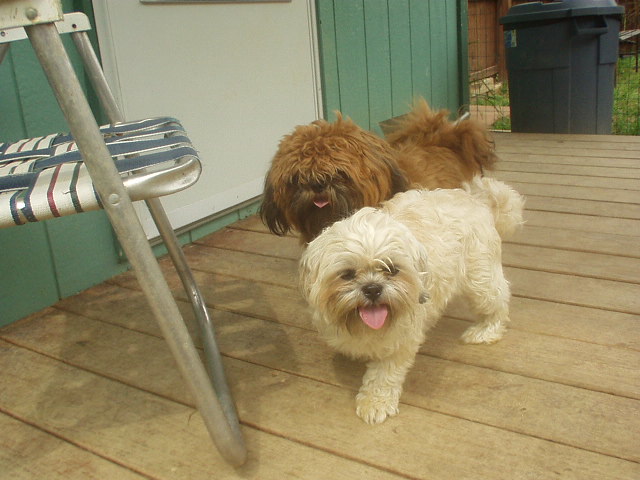
Picture features a happy pair of Opie and Taffy. They will have a litter of Shih Tzu puppies in November.

The first sense of a Shih Tzu puppy is “scent.” The newborn Shih Tzu puppy will be able to smell the scent of the breeder immediately after the sac is broken. The Shih Tzu breeder is familiar with litters of Shih Tzu puppies before their eyes open. Up until the Shih Tzu puppy opens its eyes they became familiar with their breeder’s scent through their dam’s coat. Shih Tzu puppies learn where there is and is not a place of milk and nourishment on their mother through scent.

It is advisable that only the Shih Tzu breeder handle puppies during their first two weeks. This does limit the Shih Tzu puppy’s reality of the world around them; however, it is practicing sound early responsible care practices. As Shih Tzu puppies begin to open their eyes they become aware of differences in people. Because of this awareness, a very young Shih Tzu puppy may act violently the first time handled by anyone other than their breeder. The Shih Tzu puppy may begin to struggle or scream to be free. It really is not necessary for other people besides the breeder to handle Shih Tzu puppies during this very early period of their lives. If a Shih Tzu puppy is frightening by early interactions with other people it could set the stage for later mistrust toward all humans. It is therefore extremely important that all early contacts with a Shih Tzu puppy be positive. Once a barrier of distrust is instilled in a newborn Shih Tzu puppy, the puppy can become hard to work with and sometimes even unmanageable as adults. Limiting contact with humans also aids in the spreading of germs to newborn Shih Tzu puppies.

There is a proper way to hold a very young Shih Tzu puppy. You should not “swoop” a Shih Tzu puppy quickly into your arms, or hold it at arm’s length. Do not ever pick up a Shih Tzu puppy by its legs, ears, tail or scruff. Severe and even irreparable damage can result.

Use the following steps to pick up and hold a newborn and very young Shih Tzu puppy:

Place your hands firmly around the Shih Tzu puppy’s body making it feel secure before it is lifted from the whelping box.
Immediately begin to snuggle the Shih Tzu puppy closely to your neck, chest or face area, letting the Shih Tzu puppy smell your familiar scent. Here is where the Shih Tzu puppy will feel the reassuring rhythm of your breathing and your heartbeat. The Shih Tzu puppy will remain relaxed. The Shih Tzu puppy will have less tendency to struggle against others first holding them if you will practice these steps from the beginning.

In general, you should not place very young Shih Tzu puppies in your lap, at least until after they begin to walk. They do not feel secure in a lap position at a very young age.

When handling newborn Shih Tzu puppies it is helpful to make “kissing” sounds near their ears. The sound is similar to puppies nursing. Therefore, repetitious kissing offers the same sense of security and comfort for the Shih Tzu puppy.

One of the earliest conditionings a Shih Tzu puppy encounters is being nestled in secure comfort by its dam while being fed warm milk. When you emit the same type of sounds with repetitious kissing the Shih Tzu puppy responds immediately to your stimulation and will feel secure. The Shih Tzu puppy will snuggle rather than struggle and learn to trust humans from a very early period of their lives. This type of conditioning is important for proper development as an adult Shih Tzu and instills a “trusting” of humans rather than a “fear” of humans.

Shih Tzu puppy conditioning beyond diet is a highly important part of a professional Shih Tzu breeder’s job, and will often separate the professional breeder from the “backyard” or puppy mill breeders.

Author: Connie Limon. I raise Shih Tzu puppies from top champion bloodlines. Purchase and sign up for our newsletter online at: http://www.stainglassshihtzus.com/

This article is FREE to publish with resource box.

Sunday, August 27, 2006

Differences in Professional Breeders and backyard Breeders

Differences in Professional Breeders and “backyard” Breeders

Early in the lives of the Shih Tzu puppies, the very best of care is crucial to well-rounded Shih Tzu puppy development. Dams and their litters do not survive alone. There is more to raising Shih Tzu and the Toy breed puppies in general than truly meets the eye.

Not only does one need to carefully consider the pedigrees and health histories of each mating, but one must continue to study to become an expertise in general puppy care. Yes, there is much, much more to breeding than just putting two dogs together and allowing nature to take its course. Dog breeding is a science. It is a discipline. It is a profession.

Shih Tzu breeding must be carefully thought out and is most definitely a profession that does require specialized knowledge. Regardless of the location of your breeding establishment, whether it is in your backyard, your garage, basement or an establishment that is especially built for breeding purposes, you the breeder is who makes your establishment professional or non-professional. The breeder is who determines what type of establishment, professional or non-professional, the breeding establishment is. Location, such as the backyard, basement or buildings especially designed for breeding purposes does not determine whether or not the establishment is professional.

If a breeder fails in their responsibilities to the early lives of Shih Tzu puppies, it is either through ignorance or lack of commitment. Ignorance, lack of knowledge and lack of commitment more closely defines the “backyard” breeder, and or those raising puppies in puppy mills. The committed and professional breeder realizes there is no real profit in rearing a litter of Shih Tzu puppies other than the satisfaction of doing the best job possible.

Once Shih Tzu puppies open their eyes the real work and expense of rearing a litter begins. Shih Tzu puppies begin to display individual character traits. It is at this time that Shih Tzu puppies rely more heavily upon the breeder and less with the dam. The professional breeder recognizes and readily assumes the responsibilities of caring for a Shih Tzu litter and does not abandon them to their dam’s care alone.

A large Shih Tzu litter may require supplementary feeding while continuing to allow the dam and offspring full access to each other. Smaller or premature Shih Tzu puppies often require supplementary feeding around the clock. The healthy brood matron should be vibrant, should not carry excess weight nor appear undernourished. An emotionally and physically healthy dam consistently maintains an active and lively interest in her puppies and environment. The professional breeder must be observant enough to care for the captain (the brood matron) just as well as to care for the Shih Tzu litter providing her with adequate food, water and emotional support.

There are very distinctive differences between the “backyard” unprofessional breeder and the professional breeder, some of which are detailed here in this article. There are many other differences, far too many to mention in one article.

Author: Connie Limon. I raise Shih Tzu puppies from top champion bloodlines. Visit us, sign up for our newsletter and purchase online at: http://www.stainglassshihtzus.com

This article is FREE to publish with resource box.

Sunday, August 20, 2006

Newborn Shih Tzu Puppies and Early Surroundings

Newborn Shih Tzu Puppies and Early Surroundings

Shih Tzu puppies begin to make noises shortly after their eyes open. They will also begin to try and get up and waddle around the whelping box at this time. Between 3 and 4 weeks you might want to provide new Shih Tzu puppies with a new safe daytime area for extra stimulation. A new larger area physically stimulates and mentally challenges newborn Shih Tzu puppies. Be sure the new area has good footing. Before this time the Shih Tzu dam may protest about moving her offspring. At about 3 or 4 weeks, however, usually the Shih Tzu dam will agree to a new spot. The dog’s earliest ancestors that were related to the wolf actually utilized several den sites. The first den was used for whelping. The second den was always larger to provide the offspring with safe areas of exploration. Once Shih Tzu puppies are large enough to clamber out of the whelping box, they need an area large enough to clearly define sleeping, eating, playing and toilet areas.

If you are using your garage or basement to raise Shih Tzu puppies please check for conditions that can be dangerous or lethal. Stairwells can cause fatality if Shih Tzu puppies explore them and fall. Trapped ammonia fumes from urine are toxic. Heating systems, electrical panels and appliances require thorough checking before placing a litter nearby. A garage should be thoroughly cleaned. Physical objects, cleaning abrasives, stored gasoline, motor oil or paint must be removed.

A safe play area can be created by using a garage’s side door to the yard. Block the areas under and around the door from cold and dam drafts. Flooring should have a firm, no slippery surface.

Line your whelping box with clean soft blankets or towels in the beginning. If carpeting is used, it should be washable. Do not use indoor/outdoor carpeting. Manufacturing chemicals can react with urine. Use of these materials can cause burns to the bodies of Shih Tzu puppies. Do not use newspapers in the whelping box. Newspapers are slick and contain chemicals used in the ink. Do not use wood shavings in the whelping box. Wood shavings can be inhaled or ingested which also can cause fatalities.

When Shih Tzu puppies begin to move around inside the box, house-training can be stimulated by separating the whelping box into two areas, sleeping and eliminating. Even very young Shih Tzu puppies do not like to eliminate where they sleep, eat and play. Within a few days, puppies learn to move away from their sleeping area to eliminate. Use removable sides in the whelping box to encourage them to sleep in the whelping box and eliminating away from it. If you use a heat lamp, use it only in the sleeping and playing areas.

The Shih Tzu dam will require an area to close to her Shih Tzu puppies but a place where she can relax away from them.

Healthy Shih Tzu puppies will sleep on top of each other. Once out of the whelping box an small airline crate with the door removed makes an effective dog house for Shih Tzu puppies to rest and sleep with each other. This early use of an airline crate provides the new owner with several advantages. The newly arrived Shih Tzu puppy readily accepts the familiar airline crate as sleeping quarters, making the adjustment to a new home less traumatic.

Author: Connie Limon. I raise Shih Tzu puppies from top champion lines for pet owners and to approved homes for show and/or breeding. Purchase online and sign up for our newsletter at: http://www.stainglassshihtzus.com

This article is FREE to publish with resource box.

Tuesday, August 15, 2006

Bottle Feeding Orphan Shih Tzu Puppies

Bottle Feeding Orphan Shih Tzu Puppies

Nursing bottles for orphaned Shih Tzu puppies can be obtained through the veterinarian, pet supplier, wholesale catalogs or the internet. You should purchase several nipple styles to see which works best for you and your Shih Tzu.

Shih Tzu puppies can become colicky just like human newborn babies. Be careful about allowing a Shih Tzu puppy to ingest air when either tube or bottle feeding. Always turn the bottle and nipple end down, before offering it to the Shih Tzu puppy. All the air in the bottle will rise to the solid end. When the Shih Tzu puppy is nursing freely bubbles rise in the bottle. The bubble flow should be fairly rapid, small and uniform in size, rising in even response to the Shih Tzu puppy’s nursing. If the bubbles are large the Shih Tzu puppy may also be ingesting air. Check the nipple cap.

Occasionally remove the bottle from the Shih Tzu puppy’s mouth to allow a return passage of air back into the bottle. A return passage of air occurs either through turning the bottle upright or by momentarily loosening the cap. Do not abruptly pull the bottle from the Shih Tzu puppy’s mouth. Place a finger in the corner of the Shih Tzu puppy’s lip to break the nursing hold.

Some Shih Tzu puppies may instinctively resist the unnatural feel of a manufactured nipple.
If the dam is available, rub the bottle and nipple and a towel over her mammaries.
Drape this towel across your stomach and lap.
Hold the puppy on your lap against your abdomen.
Express a small amount of formula from the bottle and wipe it over the nipple.
As you introduce the bottle’s nipple to the Shih Tzu puppy’s mouth, move your legs slightly, jiggling your lap.
Also jiggle the bottle up and down in the puppy’s mouth using tiny motions. The movements re-create the dam’s breathing and Shih Tzu puppy’s nursing position on the dam that should cause the Shih Tzu puppy to instinctively and reflexively latch onto the nipple.
Have lots of patience.

You will need to burp the bottle fed Shih Tzu puppy after each feeding. Do not allow the Shih Tzu puppy to nurse the bottle dry to avoid a colicky baby. You can burp your Shih Tzu puppy the same as you would a newborn human baby on your shoulder with gentle pats and rubs between the shoulder blades.

Connie Limon is a Shih Tzu breeder. She publishes a FREE weekly newsletter with a focus upon health and wellness for you and your pets. Designer pet clothing is available on the website. Discounts are offered to subscribers. Sign up at: http://www.stainglassshihtzus.com

This article is FREE to publish with resource box.

Monday, August 14, 2006

Shih Tzu Mammary Gland Care After Whelping

Shih Tzu Mammary Gland Care after Whelping

It is necessary to examine your Shih Tzu matron’s mammary glands daily, directly before whelping and throughout nursing and weaning periods. A secretion of moderately thick liquid clear or brown with streaks of white milk is normal. If this discharge is bloody or yellowish in color you need to consult with your vet. The first secretion, known as colostrums, is normal and present in every new mother. Colostrums contain the mother’s antibodies and are necessary to newborn Shih Tzu puppies, particularly in the first 24 hours of life. If you are tube or bottle feeding, and the Shih Tzu dam has colostrums, express some into the formula. Keep your Shih Tzu dam updated on immunizations prior to mating time. Never vaccinate a pregnant Shih Tzu. The antibodies in the colostrums protect the newborn Shih Tzu puppies against infectious diseases to which the mother is immune.

Shih Tzu matrons will shed hair along the abdomen prior and after whelping. However, since the Shih Tzu has so much hair, it is likely you will need to trim close also. The best is to shave down the entire abdomen and genitalia area just prior to whelping. Shih Tzu puppies can ingest air while nursing if hair remains around the mammaries. The presence of hair also collects milk and promotes rapid bacterial growth and can cause illness in the Shih Tzu puppies, which can lead rapidly to death.

Heavy mammary glands require daily washing and thorough drying of the entire abdominal area until the Shih Tzu puppies are weaned. The Shih Tzu dam’s milk glands should always feel pliable, being moderately soft although heavy and full feeling to your examination. Your Shih Tzu matron is in trouble should there be any hardness in an entire individual gland or row, visible redness and/or red streaks or yellowish or bloody discharge expressed. Placing a bandage over the nipple of the affected teat is usually sufficient to stop very young Shih Tzu puppies from nursing. Use a small amount of camphorated oil of Vicks VapoRub to stop older Shih Tzu puppies from nursing at an infected site. Seek veterinarian care for your Shih Tzu matron. Nursing from infected mammary glands could cause serious illness and diarrhea in the Shih Tzu puppies.

Connie Limon is a Shih Tzu breeder. She publishes a FREE weekly newsletter with a focus upon health and wellness for you and your pets. Designer pet clothing is available on the website. Discounts are offered to subscribers. Sign up at: http://www.stainglassshihtzus.com

This article is FREE to publish with resource box.

Saving Orphaned Shih Tzu Puppies

Saving Orphaned Shih Tzu Puppies

If you want to save your orphaned Shih Tzu puppies you must be totally dedicated to them on a 24-hour-a-day, 7-day-a-week basis for the first few weeks of life. Raising orphaned Shih Tzu puppies is the most challenging and taxing task any Shih Tzu breeder could undertake. Success is gratifying.

Maintain the Shih Tzu puppies in an incubator environment with a temperature of at least 90 degrees Fahrenheit to start out. Reduce the temperature to 85 degrees after three or four successful days and you see the Shih Tzu puppies are stable. Slowly decline the temperature by small increments. After a week the temperature can be slowly declined to 80 degrees Fahrenheit. Maintain this temperature until the Shih Tzu puppies are three to four weeks of age. After four weeks the temperature may be reduced to 75 degrees.

Orphaned Shih Tzu puppies are prime candidates for failure-to-thrive syndrome. Under normal conditions, the Shih Tzu puppy is bumped and shoved instinctively with littermates. These natural instincts insure that the Shih Tzu puppies use their body, pushing toward the dam for nursing, pushing in rivalry against littermates. The dam vigorously washes her offspring, cleaning the Shih Tzu puppies and bringing about elimination. This tactile stimulation is crucial to the development of a strong healthy puppy.

You must effect stimulation by gentle periodic stroking with one or two fingers, awakening the Shih Tzu puppies directly prior to feeding. During feeding periods it is necessary to snuggle the Shih Tzu puppies to simulate the same type of nurturing the dam would have provided. You become a surrogate dam to orphaned Shih Tzu puppies.

Shih Tzu puppies are born with sealed eyes. The Shih Tzu puppy is unable to hear at birth. You as the surrogate dam will need to artificially stimulate the orphaned Shih Tzu puppy to defecate and urinate. You can do this easily by using a cotton swab dipped in baby oil. Gently swab the genitalia and anus area until the Shih Tzu puppy urinates and defecates. The surrogate dam must stimulate Shih Tzu puppies to elimination on the same regular basis as feeding intervals. The orphaned Shih Tzu puppy must be stimulated to urinate and defecate at each feeding interval until able to independently perform these functions.

Consult with your vet as to which puppy milk formula you should use, and the type of feeding method.

Connie Limon is a Shih Tzu breeder. She publishes a FREE weekly newsletter with a focus upon health and wellness for you and your pets. Designer dog clothes are offered on the website. Discounts are offered to subscribers. Sign up at: http://www.stainglassshihtzus.com

This article is FREE to publish with resource box.

Thursday, August 10, 2006

Learning to Tube Feed Shih Tzu Puppies

Learning to Tube Feed Shih Tzu Puppies

It is not difficult to learn the correct tube feeding procedure. Purchase the tube feeder through your veterinarian, who will be able to equip you with the correct diameter catheter and syringe size for your Shih Tzu. Sterilize both catheter and syringe between early feedings. The syringe will have graduated markings on the side to record accurate intake. You will need a bowl or large measuring cup for warm water, a candy thermometer and a nontoxic indelible pen or dull knife.

Place water heated to 100 degrees Fahrenheit in the bowl or measuring cup.
Heat the formula separately (also to 100 degrees Fahrenheit) using the candy thermometer to regulate the temperatures of both liquids.
Put the thermometer, syringe, catheter and warmed formula into the bowl of water for transport to the Shih Tzu puppy.

Each puppy should be measured for gavage feeding. Correct measurement is crucial to the Shih Tzu puppy’s well-being.

Lay each puppy flat on it side on a towel.
Measure the catheter from the rounded tip held at a point just behind the Shih Tzu puppy’s last rib, along the side of the chest and throat, to just in front of the Shih Tzu puppy’s muzzle.
Mark the spot of the Shih Tzu puppy’s muzzle on the catheter with the pen or dull knife.

If you get the catheter too short, the formula may be aspirated by the Shih Tzu puppy. If you introduce a catheter too long it can puncture through the newborn Shih Tzu’s delicate stomach wall. Have your vet walk you through the procedure.

If the end of the catheter is too wide to allow attachment to the syringe, sever the catheter directly behind the beginning of the flute to allow secure attachment to the syringe. Now that you have the syringe attached, place the catheter end into the warmed formula and withdraw the syringe from the plunger. Fill the syringe a few milliliters over the amount directed by your vet. Keep the catheter tip pointed downward, preventing air from getting in.

Place the Shih Tzu puppy on a towel in your lap, head elevated in a slightly inclined position. Wrap one hand around the back of the Shih Tzu puppy’s head, palm against the back of the skull.
Stroke the Shih Tzu puppy with your thumb and opposing fingers on each side of the muzzle by the lip corners. The Shih Tzu puppy should respond by opening its mouth.
Always keep the syringe elevated and the catheter end pointing downward.
You want very small amounts of formula to slowly drip from the catheter’s tip, preventing air from getting in.
Directly and gently introduce the tube through the front of the Shih Tzu puppy’s mouth. Never force a catheter down a Shih Tzu puppy’s throat. Never insert at an angle.
The Shih Tzu puppy may at first struggle at the catheter’s introduction. Do not push if the catheter does not slip easily down the esophagus. Withdraw the catheter and try again. If the Shih Tzu puppy struggles against the introduction of the catheter, gently apply a small amount of steady pressure to the catheter against the Shih Tzu puppy’s resistance; the Shih Tzu puppy should reflexively swallow. The passage should suddenly open and the tube should slide down easily.
The catheter is in correct position when the mark you made is just slightly beyond the tip of the Shih Tzu puppy’s muzzle.
Slowly depress the syringe plunger to begin feeding.
Never feed a Shih Tzu puppy until its abdomen is distended and hard. If the Shih Tzu puppy’s stomach remains flaccid, you have not fed enough. Feed half the formula, and then burp the Shih Tzu puppy.
Be sure to have your vet walk you through the correct procedure for tube feeding before you try this yourself.

Connie Limon is a Shih Tzu breeder. She publishes a FREE weekly newsletter with a focus upon health and wellness for you and your pets. Designer Pet Clothing is offered on the website. Sign up at: http://www.stainglassshihtzus.com

This article is FREE to publish with resource box.

Wednesday, August 09, 2006

Banana Drop Spoonful Treats

Banana Drop Spoonful Treats
Makes about 20


1 ½ cups ripe mashed bananas
½ teaspoon vanilla
3 cups oats
½ cup chopped peanuts
¼ cup applesauce

Preheat oven to 350 degrees.
Mix all ingredients together thoroughly.
Drop spoonfuls of the mixture onto an ungreased baking sheet, and press flat with a fork.
Bake for approximately 15 minutes, and then cool on a rack before serving. Store in an airtight container.

Monday, August 07, 2006

Learning To Recognize Aggressive Behaviors in Your Shih Tzu

Learning to Recognize Aggressive Behaviors in Your Shih Tzu

Generally speaking Shih Tzu should not be aggressive at all. However, with any breed of dog aggressive behaviors can and do occur. Do you understand what it means if a Shih Tzu bares its teeth at you? Is your Shih Tzu warning you to back off or is your Shih Tzu simply smiling? If your Shih Tzu suddenly snaps at you – is this a failed bite or a warning that a bite might be coming next? The truth is these are typically aggressive behaviors that can range from visual warnings to postural or symbolic threats. Every dog owner needs to learn these subtle or not so subtle warnings of aggression, whether it be with a Shih Tzu or a Pit Bull. Any dog breed can exhibit aggression.

Dog aggression is often meant primarily not to harm so much as to alter the behavior of another creature, human or animal. Dogs and Shih Tzu included communicate their aggressive intentions through changes in expression, posturing, and maneuvering, some so subtle as to be easily missed or misunderstood by a passerby or even the owner. A dog’s communication system is quite different from a human’s communication system. It is important that every dog owner, whether it be a Shih Tzu or a Pit Bull, or a tiny teacup poodle, learn the dog’s basic communication system expressing aggression.

The actual bite is often preceded by several aggressive responses and warnings. These might include staring, growling, tensing up, and walking stiffly. No one, however, would misinterpret the savage attack of a child by a Pit Bull, as anything other than pure aggression and most people would also interpret the attack as the dog being absolutely uncontrollably vicious. In a breed such as the Shih Tzu, one does not normally see such types of viciousness, however, as with all canines, it is possible. All canines are related to the wolf and even though humans have domesticated them extremely well they can still from time to time exhibit those wolf like behaviors.

Aggression may develop gradually in a pup as it matures. Play growling and nipping by puppies and Shih Tzu puppies as well may seem harmless, but they often represent warning signals of what can be possible later on. Growling and nipping in Shih Tzu puppies needs to be handled immediately and eradicated. The mouth of a Shih Tzu puppy should never be allowed on human skin regardless of the activity. One possible way of handling a mouthing Shih Tzu puppy on human skin is to immediately close the mouth of the Shih Tzu puppy and hold it tight while saying sternly to the Shih Tzu puppy – NO BITE.

All Shih Tzu puppies are prone to want to chew. They are teething and this is a very normal behavior, however, when it is transferred to human skin, it is not normal and not acceptable. It can be solved if caught in the early stages assuming there are no other emotional problems occurring with the Shih Tzu puppy. You can also quickly put a chewable object in the mouth of the mouthing Shih Tzu puppy.

Connie Limon is a Shih Tzu breeder. She publishes a FREE weekly newsletter. Sign up at: http://www.stainglassshihtzus.com Designer Dog Clothes are offered on the website.

This article is FREE to publish with resource box.

Shih Tzu - Difficult Deliveries

Shih Tzu – Difficult Deliveries

Most Shih Tzu puppies present themselves normally at birth. There are times, very few times, of which I have experienced with the Shih Tzu that required assistance. Usually the most difficult Shih Tzu puppy birth is the first one. Delivery of a dry Shih Tzu puppy or overly large Shih Tzu puppy can take longer than normal and may affect the next Shih Tzu puppy birth. This next Shih Tzu puppy may be stillborn or have more fluid in the trachea and lungs. Oftentimes, subsequent Shih Tzu siblings are born normally.

Not every stillborn Shih Tzu puppy or difficult delivery is the result of a Shih Tzu matron suffering inertia. The problem of inertia, however, will cause a higher percentage of stillborn Shih Tzu puppies. Shih Tzu puppies are normally vigorous while attached to the uterine wall. Once freed from the uterine wall, a Shih Tzu puppy has limited time in which to arrive.

Once the Shih Tzu puppy has arrived, time is crucial. If the matron does not immediately tear the sac from around the puppy. You must quickly tear the sac from the Shih Tzu puppy’s face, nose and mouth and then proceed to remove the sac from the rest of the Shih Tzu puppy’s body. Rub the Shih Tzu puppy briskly while it is in a head-down position. Use a pediatric bulb syringe to suction the Shih Tzu puppy’s oral cavity. Clear the trachea and lungs by shaking the Shih Tzu puppy down. Each direction of the arc’s swing should take about 3 seconds. Repeat the procedures several times until the Shih Tzu puppy’s oral and tracheal passages are cleared as much as possible.

Dry Delivery:
A dry delivery is when the Shih Tzu puppy’s protective sac breaks inside the birth canal. A dry Shih Tzu puppy delivery can either a head-first or breech (rear quarters first). A Shih Tzu puppy breech birth is a normal canine birth position; however, a dry breech delivery can be dangerous to a Shih Tzu puppy. The Shih Tzu puppy is presented entirely or partially free of a sac. If the Shih Tzu puppy’s legs get stuck delivery progress is impeded. The Shih Tzu puppy’s head may turn back blocking passage or even its body turned sideways in the birth canal. Under these circumstances the Shih Tzu dam cannot deliver without assistance. Cooking oil may be substituted in an emergency to use as a lubricant.

While it is most important to get a Shih Tzu puppy breathing on its own as quickly as possible, the Shih Tzu puppy must never be pulled indiscriminately. You need to work with the Shih Tzu dam’s contractions. Place one hand in the dam’s inguinal area directly behind the Shih Tzu puppy’s position in the birth canal and exert a slight pressure to help prevent backward slipping. Grip the Shih Tzu puppy firmly with a towel in the other hand to prevent the Shih Tzu puppy from being withdrawn. Wait for the next contraction and exert a slight, steady pulling pressure downward toward the Shih Tzu dam’s feet. One or two contractions are usually enough to deliver the Shih Tzu puppy.

Your hands must be scrubbed, your nails trimmed and filed smooth in case adjusting the Shih Tzu puppy’s position is necessary. Use sterile surgical gloves or dip your hands in surgical antiseptic. Using a small amount of lubricant, gently insert one or two fingers into the Shih Tzu matron’s vagina. The Shih Tzu puppy should be palpable presenting facing the dam’s feet. You can feel if the Shih Tzu puppy is still confined or if the sac has been broken. If the Shih Tzu puppy is still in the sac, additional lubricant will not be needed.

If the Shih Tzu puppy’s head is foremost, gently ease the legs into the correct birth position. Gently push the Shih Tzu puppy a few millimeters back into the birth canal. Reposition the Shih Tzu puppy with the forelegs extended first. The Shih Tzu dam should then have little difficulty expressing the Shih Tzu puppy with one or two more contractions. Firmly hold the Shih Tzu puppy as it is presented and withdrawn back inside the birth canal at the end of contractions. If the Shih Tzu puppy presents itself head-first, keep the puppy’s face down toward the dam’s feet. If it is a breech delivery, hold the Shih Tzu puppy’s hind feet “facing” the dam’s paws.

Connie Limon is a Shih Tzu breeder. She publishes a FREE weekly newsletter. A professional newsletter with a focus upon health and wellness for you and your pets. Discounts are offered to subscribers. Sign up at: http://www.stainglassshihtzus.com

This article is FREE to publish with resource box.

Sunday, August 06, 2006

Teaching Bite Inhibition to Shih Tzu Puppies

Teaching Bite Inhibition to Shih Tzu Puppies

Shih Tzu puppies, like children, will never be perfect in behaviors. A certain amount of tolerance is expected, but it is well to understand a Shih Tzu puppy’s messages so you can react to reshape unwanted behaviors when limits are exceeded.

All puppies are “mouthy” during the teething process, however, there are exceptions in that you will encounter Shih Tzu puppies that just won’t take no for an answer and keeps chomping on people’s hands instead of those objects given him to chew on.

First try to understand what nipping means to a Shih Tzu puppy. Put yourself in the shoes of a Shih Tzu puppy. A six to eight week old Shih Tzu puppy finds itself a reasonably confident navigator of its environment. The Shih Tzu puppy may try to explore everything it can and uses one tool with which to investigate its environment – its mouth, not much unlike a small human toddler. To a Shih Tzu puppy, its mouth is like a hand used for exploration of its environment. Generally speaking at this time, the Shih Tzu puppy is not at all vicious or mentally disturbed because they display mouthing behaviors. In fact, this is a very normal behavior in which Shih Tzu puppies use to discover and explore their surroundings.

Shih Tzu puppies direct their first oral attentions to their mother’s soft underbelly where they find nourishment. If a Shih Tzu puppy bites its mom too hard during nursing she will rebuke the puppy. This is the Shih Tzu puppy’s first lessons in inappropriate “nipping or biting.” He learns to listen to mommy. As the Shih Tzu puppy matures mouthing behaviors are directed toward littermates during play. When one puppy becomes too rough during this type of play the others usually complain loudly and withdraw. The biting Shih Tzu puppy learns to be a little easier on littermate if the fun and games are to continue. The puppy begins to learn bite inhibition. The puppies that are bitten learn to avoid the circumstances that lead to the painful consequence and that withdrawing are a good defense strategy.

Almost every Shih Tzu puppy finds itself in a new home without a disciplinary “mom,” and former littermates. Instead the Shih Tzu puppy has doting human owners who must serve as parents and siblings rolled into one unit. What happens when the Shih Tzu puppy wants to play, can’t find its littermates and nips a human?

A person knowledgeable about puppy matters might react like the mother dog or a littermate with a sharp rebuke, maybe with words like “Stop it” or “Ouch” or a light tap on the nose with a finger, and/or immediate withdrawal of attention. You might even respond by closing the Shih Tzu puppy’s mouth tightly and saying sharply “NO BITE” then place an object that is acceptable for biting into the Shih Tzu puppy’s mouth.

Connie Limon is a Shih Tzu breeder. She publishes a FREE weekly newsletter. Sign up at: http://www.stainglassshihtzus.com Designer Dog Clothes are offered on the website.

This article is FREE to publish with resource box.

Friday, August 04, 2006

Danny Boy Birthday Bones

DANNY BOY BIRTHDAY BONES
Makes 30 large bones


2 cups whole-wheat flour
1 tablespoon baking powder
1 cup natural peanut butter
1 cup skim milk


Preheat oven to 375 degrees.
In a bowl, combine flour and baking powder. In another bowl, mix peanut butter and milk.
Add wet mixture to dry, and mix well.
Turn out dough on a lightly floured surface and knead. Roll out to ¼-inch thick and cut out shapes.
Place on a greased baking sheet and bake for 20 minutes or until lightly brown. Cool on a rack then store in an airtight container.

Thursday, August 03, 2006

Why Do Dogs Bark?

Why Do Dogs Bark?

Barking is probably one of the most negative qualities attributed to dogs and/or Shih Tzu. Incessant barking is always irritating to owners and anyone surrounding the incessant barking dog or Shih Tzu.

Shih Tzu barks for a variety of reasons. Owners need to find out what is causing the barking before the problem can be successfully addressed.

Some twelve thousand years ago primitive man and the domestic dog’s ancestors coexisted rather than shared intimate relationships we enjoy today with their descendants. As dogs begin to show friendliness, playfulness and alarm barking humans began to domesticate them. As humans began to appreciate the dog’s presence a bond was woven between humans and dog companions over time.

Barking due to territoriality most likely served as an alarm function in days when it was even more important that it is today to know when someone or something was encroaching upon human territory.

Another characteristic “some” dogs, and definitely includes our Shih Tzu is its appearance to the human eye. Dogs that are cute with infantile facial features which stimulate human parenting instincts provide additional bonding.

All domestic dogs bark, including the Shih Tzu. Once a chorus starts every dog within hearing distance will join in. Soon you have a “barking” orchestra, and if you are lucky enough to be hard of hearing at that time wearing your hearing aids, just simply pull them out until the concert is over……..

Barking is one way dogs and Shih Tzu communicates with each other and with their human companions. I have heard some of my Shih Tzu actually say words during their barking sessions. Duke will say: “I’m Mad.” “I’m Mad,” and at that time I am certain his barking is most definitely because he is mad about something. His word was toward one of his buddies. When Duke wants to be where I am and he is in a spot in which he feels “trapped,” cannot get to me, his bark is much different. It is more like a “scream.” He has not put words together yet, but I feel fairly certain he probably is saying to me: “let me come in there, I can’t wait any longer, I want in there now!” Once I allow him his wishes, his barking stops.

Owners need to find out the cause of their Shih Tzu’s barking and then proceed with steps to solve the problem. There is no way around it. All dogs, including Shih Tzu, bark from time to time. Some are more vocal than others, just as humans, some humans talk more than others. I have Shih Tzu that rarely if ever bark for any reason.

Connie Limon is a Shih Tzu breeder. She publishes a FREE weekly newsletter. Sign up at: http://www.stainglassshihtzus.com

This article is FREE to publish with resource box.

Tuesday, August 01, 2006

Shih Tzu - Difficult Deliveries

Shih Tzu – Difficult Deliveries

Most Shih Tzu puppies present themselves normally at birth. There are times, very few times, of which I have experienced with the Shih Tzu that required assistance. Usually the most difficult Shih Tzu puppy birth is the first one. Delivery of a dry Shih Tzu puppy or overly large Shih Tzu puppy can take longer than normal and may affect the next Shih Tzu puppy birth. This next Shih Tzu puppy may be stillborn or have more fluid in the trachea and lungs. Oftentimes, subsequent Shih Tzu siblings are born normally.

Not every stillborn Shih Tzu puppy or difficult delivery is the result of a Shih Tzu matron suffering inertia. The problem of inertia, however, will cause a higher percentage of stillborn Shih Tzu puppies. Shih Tzu puppies are normally vigorous while attached to the uterine wall. Once freed from the uterine wall, a Shih Tzu puppy has limited time in which to arrive.

Once the Shih Tzu puppy has arrived, time is crucial. If the matron does not immediately tear the sac from around the puppy. You must quickly tear the sac from the Shih Tzu puppy’s face, nose and mouth and then proceed to remove the sac from the rest of the Shih Tzu puppy’s body. Rub the Shih Tzu puppy briskly while it is in a head-down position. Use a pediatric bulb syringe to suction the Shih Tzu puppy’s oral cavity. Clear the trachea and lungs by shaking the Shih Tzu puppy down. Each direction of the arc’s swing should take about 3 seconds. Repeat the procedures several times until the Shih Tzu puppy’s oral and tracheal passages are cleared as much as possible.

Dry Delivery:
A dry delivery is when the Shih Tzu puppy’s protective sac breaks inside the birth canal. A dry Shih Tzu puppy delivery can either a head-first or breech (rear quarters first). A Shih Tzu puppy breech birth is a normal canine birth position; however, a dry breech delivery can be dangerous to a Shih Tzu puppy. The Shih Tzu puppy is presented entirely or partially free of a sac. If the Shih Tzu puppy’s legs get stuck delivery progress is impeded. The Shih Tzu puppy’s head may turn back blocking passage or even its body turned sideways in the birth canal. Under these circumstances the Shih Tzu dam cannot deliver without assistance. Cooking oil may be substituted in an emergency to use as a lubricant.

While it is most important to get a Shih Tzu puppy breathing on its own as quickly as possible, the Shih Tzu puppy must never be pulled indiscriminately. You need to work with the Shih Tzu dam’s contractions. Place one hand in the dam’s inguinal area directly behind the Shih Tzu puppy’s position in the birth canal and exert a slight pressure to help prevent backward slipping. Grip the Shih Tzu puppy firmly with a towel in the other hand to prevent the Shih Tzu puppy from being withdrawn. Wait for the next contraction and exert a slight, steady pulling pressure downward toward the Shih Tzu dam’s feet. One or two contractions are usually enough to deliver the Shih Tzu puppy.

Your hands must be scrubbed, your nails trimmed and filed smooth in case adjusting the Shih Tzu puppy’s position is necessary. Use sterile surgical gloves or dip your hands in surgical antiseptic. Using a small amount of lubricant, gently insert one or two fingers into the Shih Tzu matron’s vagina. The Shih Tzu puppy should be palpable presenting facing the dam’s feet. You can feel if the Shih Tzu puppy is still confined or if the sac has been broken. If the Shih Tzu puppy is still in the sac, additional lubricant will not be needed.

If the Shih Tzu puppy’s head is foremost, gently ease the legs into the correct birth position. Gently push the Shih Tzu puppy a few millimeters back into the birth canal. Reposition the Shih Tzu puppy with the forelegs extended first. The Shih Tzu dam should then have little difficulty expressing the Shih Tzu puppy with one or two more contractions. Firmly hold the Shih Tzu puppy as it is presented and withdrawn back inside the birth canal at the end of contractions. If the Shih Tzu puppy presents itself head-first, keep the puppy’s face down toward the dam’s feet. If it is a breech delivery, hold the Shih Tzu puppy’s hind feet “facing” the dam’s paws.

Connie Limon is a Shih Tzu breeder. She publishes a FREE weekly newsletter. A professional newsletter with a focus upon health and wellness for you and your pets. Discounts are offered to subscribers. Sign up at: http://www.stainglassshihtzus.com

This article is FREE to publish with resource box.

Saturday, July 22, 2006

Shih Tzu Postpartum Care

Shih Tzu Postpartum Care

Whelping a litter of Shih Tzu puppies can sometimes be physically and emotionally exhausting for both you and the Shih Tzu matron. Before you take your well deserved rest, be certain the Shih Tzu matron and Shih Tzu puppies are comfortable, each Shih Tzu puppy has nursed well, the heat lamp is not too close, and the heating pad is not turned up too high. At this time it is crucial to maintain proper environmental temperatures. Newborn Shih Tzu puppies are incapable of controlling their own body temperatures. Chilling to any degree leaves newborn Shih Tzu puppies susceptible to infectious disease. Room temperature should be maintained at about 85 degrees Fahrenheit for at least their first few days.

Initially offer your Shih Tzu dam only soft, messy-type foods and supplements of a high quality milk replacement added to her food. I like using Pedigree Lamb and Rice canned formula with Just Born milk replacement powder sprinkled on top or mixed within.

Most Shih Tzu dams are ready for a good meal once whelping is over and the puppies are all settled in nursing well. However, do not worry if she refuses one or two feedings during her first 24 hours of motherhood. Do not expect her to leave her newborn Shih Tzu puppies. If she is too exhausted to eat right after whelping, she will be ready by the next day most usually.

To prevent serious cleanup problems, place four interlocking layers of open newspaper on the floor over heavy plastic film such as that used by painters. Plastic sheeting covered by newspaper saves all flooring, is nonporous, makes any cleanup easy and is inexpensive to purchase.

Use Clorox bleach, ¾ cup to a gallon of water to disinfect the Shih Tzu whelping box and immediate area. You will need to disinfect daily.

Two days following whelping, offer your Shih Tzu matron soft food mixed with a high quality dog food. I use HealthyPetNet Life’s Abundance and have found it to be the absolute best food for my Shih Tzu.

Your Shih Tzu dam should be seen by a veterinarian for a postpartum examination within 24 hours of whelping. It is not uncommon for a Shih Tzu dam to retain one or more placentas, large amounts of blood and other body fluids in the uterus. It is also possible that she retained one or two Shih Tzu puppies as well. All of these need to be expelled immediately. Retention will predispose the Shih Tzu dam to infection. Many veterinarians will give the oxytocin shot within the first 24 hours of whelping to help her expel any retained fluids, placental material and/or puppies.

Connie Limon is a Shih Tzu breeder. She publishes a FREE weekly newsletter with a focus upon health and wellness for you and your pets. Pet clothing is offered on the website. Discounts are offered to subscribers. Sign up at: http://www.stainglassshihtzus.com

This article is FREE to publish with resource box.

Tuesday, July 18, 2006

Peanut Butter and Banana Dog Cookies

PEANUT BUTTER AND BANANA DOG COOKIES

2 cups whole-wheat flour
¼ cup wheat germ
1 cup water
¼ cup all-natural peanut butter (no sugar or salt added)
1 egg
1 banana, mashed

Preheat the oven to 350 degrees F. In a large bowl, combine all ingredients; mix well.
On a floured surface, knead the dough until it is firm.
Roll the dough to a ¼-inch thickness. Cut with the cookie cutter of your choice. Transfer dog cookies to a baking sheet.
Bake for 45 to 55 minutes, or until the dog cookies are dry and firm to touch. Turn off the heat; let the dog cookies stand in the oven until hard, 1 to 2 hours.

Purchase the e-book of homemade dog treats and meals at: http://www.stainglassshihtzus.com

Blog Archive